Crate Training a Dogo Argentino and Preventing Separation Anxiety
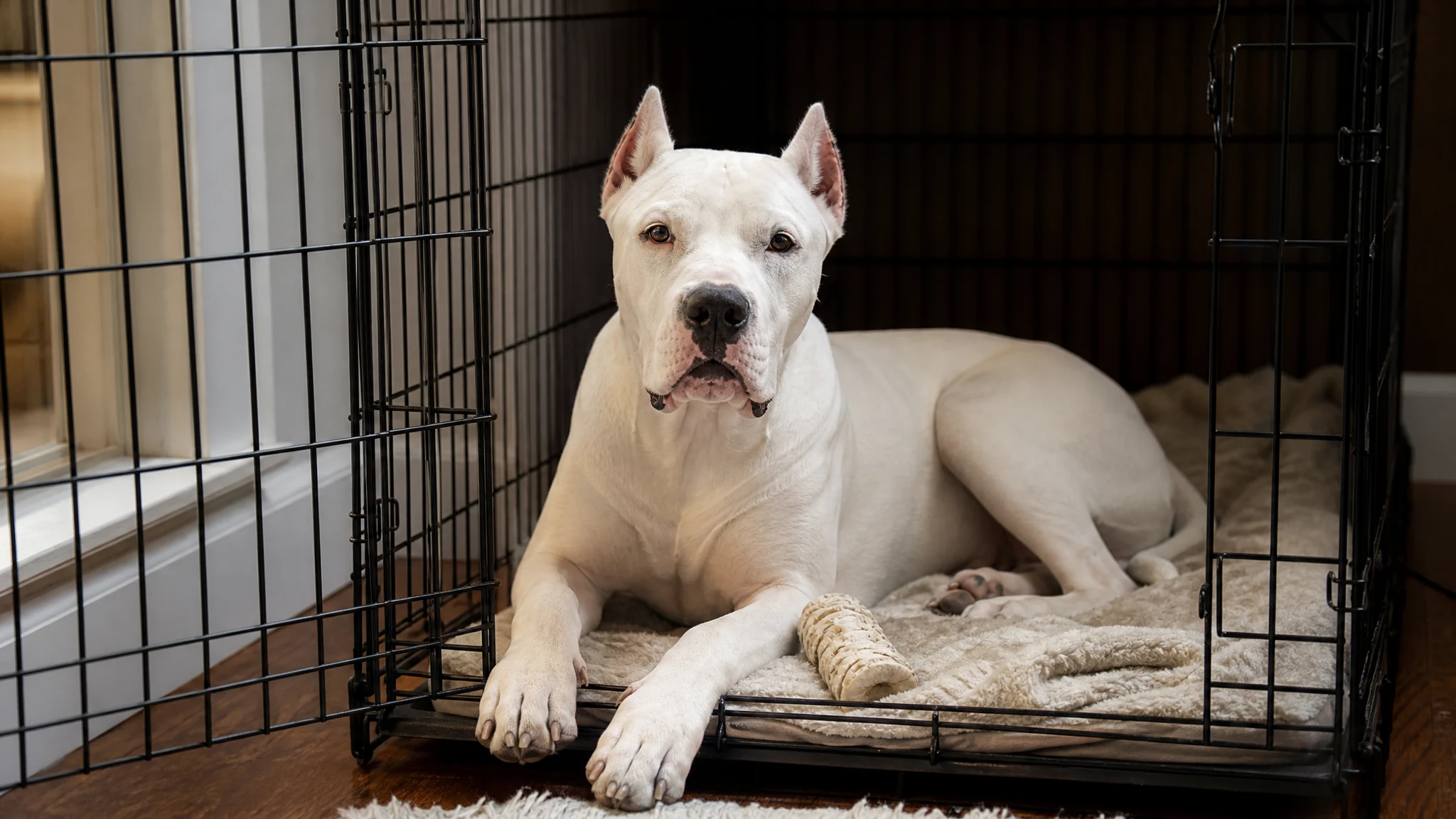
General training information. Every dog is an individual; for health or behavior concerns, see your veterinarian.
A Dogo Argentino is a big, athletic, strong-willed dog, and a crate can become a calm place for one. Done slowly, it gives your dog a safe spot to rest. It also gives you a way to manage a busy young dog when you cannot watch them.
This guide covers Dogo Argentino crate training from start to finish. It explains how to choose a size, how to introduce the crate, how to build alone time, and how to spot early signs of separation distress. It also says when to call a veterinarian.
Why crate training suits this breed
The Dogo Argentino Club of America, the parent club, says the breed was created in Cordoba, Argentina, by Dr. Antonio Nores Martinez. It was bred to protect family and property and to hunt large game such as wild boar, peccaries and pumas. The club's breed standard describes the temperament as strong, tenacious, rustic, loyal and above all courageous.
That history matters at home. PetMD lists strong prey drive and a tendency to become destructive when bored among the breed's known challenges, and says the breed is not well suited to apartment living. Chewy describes an athletic dog with a matching energy level. A crate will not fix boredom, but it can keep a young dog and your belongings safe while you build good habits.
Individual dogs vary. Some Dogos settle in a crate within days, and others need weeks of patient work.
Materials you need
- A crate sized for an adult Dogo. See the sizing section below.
- A firm, washable mat or bed. Choose one that is hard to shred. Skip bedding if your dog chews fabric.
- Soft, small treats. Use pea-sized pieces your dog loves, so you can reward many times in a session.
- A stuffable chew toy. A hollow rubber toy filled with part of a meal keeps your dog busy and happy.
- A leash and a fenced area or secure yard. PetMD notes the breed's prey drive means it needs a leash or fenced space.
- A timer or watch. You will track short absences so you can raise them gradually.
- A baby gate or exercise pen. This gives you a place to practice while you are still home.
Choosing the right crate size for a Dogo Argentino
The breed standard from the Dogo Argentino Club of America gives adult heights of 24 to 26.5 inches for males and 24 to 25.5 inches for bitches. It gives approximate weights of 88 to 100 pounds for males and 88 to 95 pounds for bitches.
So you are shopping for a large dog. Plan for an extra-large crate, because a dog this tall needs to stand up without ducking.
Use these checks instead of guessing:
- Your dog should stand up fully without the head touching the top.
- Your dog should turn around easily.
- Your dog should lie out on one side with legs stretched.
- The crate should not be so large that one end works as a bathroom. This matters most for puppies.
Measure your own dog and compare the numbers with the sizing chart from the crate maker. The Dogo Argentino Club of America does not publish crate dimensions, so check each brand's chart for the size and weight rating.
If you buy a crate for a puppy, many owners choose one adult-sized crate with a divider panel. You move the divider back as your dog grows. PetMD notes that rapid growth in this breed can strain joints, so choose a crate with a flat, stable floor and avoid anything that encourages jumping in and out.
Choose a sturdy, well-built crate. A strong, determined dog may test a flimsy one. If your dog is already pushing hard at the door or hurting themselves, do not just buy a stronger crate. Stop and talk with a veterinarian or a qualified reward-based trainer.
Step-by-step: crate training a Dogo Argentino
Step 1: Set up the crate in a social spot
Place the crate in a room where your family spends time, such as the living room or a quiet corner nearby. Dogs bred to work alongside people usually do better when they can see and hear the household. Put in the mat and a chew toy. Prop the door open or remove it so nothing can swing shut and startle your dog.
Step 2: Let your dog discover it
Toss a few treats near the crate, then just inside the door, then toward the back. Let your dog walk in and out freely. Say nothing and do not push. If your dog only sniffs it on day one, that is progress.
Step 3: Feed meals in the crate
Put the food bowl at the front of the crate, then a little farther in with each meal. When your dog is eating happily at the back, you can close the door for the length of the meal and open it before your dog finishes. PetMD says puppies can eat up to three meals a day, which gives you plenty of chances to practice.
Your veterinarian can tell you how to schedule meals, and rest and exercise around meals. The breed is listed by PetMD as prone to gastric dilatation-volvulus (GDV), and this is a question for your vet.
Step 4: Add a cue and short door closures
Pick a simple word, such as "bed," and say it once as your dog walks in. Reward right away. Once your dog goes in easily, close the door for a few seconds, give a treat through the bars, and open it again. Build up from seconds to a minute, then to several minutes, while you sit nearby.
Keep the door opening calm. Do not let your dog burst out in excitement every time. Wait for a moment of quiet, then open.
Step 5: Move around the room
With your dog resting in the closed crate, stand up, walk a few steps, sit down again and return to reward. Then leave the room for a few seconds. Gradually increase how far you go and how long you stay out of sight. Reward calm behavior, and come back before your dog starts to fuss.
Step 6: Build real alone time
This is the step that matters most for preventing separation distress. Follow this order:
- Give a long, satisfying exercise session first. Chewy says this breed needs at least an hour of intense exercise and activity every day, and PetMD says lots of daily exercise.
- Offer a stuffed chew toy and put your dog in the crate with a calm cue.
- Leave the room for one or two minutes. Return quietly, with no big greeting.
- Repeat several times a day, adding a little time only when your dog stays relaxed.
- Practice leaving through the front door for short trips. Pick up keys, put on shoes, and sometimes do not leave at all, so these cues lose their power.
- Move slowly toward longer absences. Add time in small steps, and go back a step if your dog struggles.
Keep arrivals and departures low key. Dramatic goodbyes can make leaving feel like a big event.
Preventing separation anxiety in a Dogo Argentino
Separation anxiety is a real concern for any dog that bonds closely with people. The breed standard calls the Dogo loyal, and a dog with a strong bond may find being alone hard. We have no breed-specific figures on how common separation anxiety is in Dogos, so treat the habits below as good general practice and not as a promise.
- Start early. Chewy advises positive reinforcement and starting socialization as soon as possible. Teach alone time as a normal, boring part of life from the first weeks home.
- Practice being apart while you are home. Use the gate or crate for short breaks even when you are in the next room.
- Exercise first, then rest. A tired dog is more likely to settle. Add mental work such as sniffing games and short training sessions.
- Be consistent. A club member's essay on the Dogo Argentino Club of America site, which is one owner's account and not club policy, stresses follow-through and lifelong consistency. Calm routines are worth keeping up long after puppyhood.
- Do not rush the schedule. Skipping steps is the most common reason crate training stalls.
Tips for success
- Keep sessions short and end them on a good note.
- Use the crate for rest, not as a place your dog is sent when you are upset.
- Give a chew toy only in the crate if you want it to feel special.
- Take a puppy out to relieve themselves right after waking and after the crate.
- Do not leave collars or tags that could snag on the crate. Check with the crate maker on safe practice.
- Stay with reward-based methods, in line with the American Veterinary Society of Animal Behavior. Never use shock, prong or choke collars, alpha rolls, scruffing or dominance methods.
Common mistakes to avoid
- Using the crate as punishment. Your dog will learn to dread it.
- Letting a crying dog out mid-protest. Wait for a short pause, then open the door. Better yet, avoid pushing so far that your dog cries at all.
- Leaving too long too soon. A jump from minutes to hours is a common cause of setbacks.
- Skipping exercise. PetMD says the breed can become destructive when bored. A crate cannot stand in for exercise and mental work.
- Buying a crate that is too small or too weak. Check the numbers against your own dog, not just the label.
- Ignoring prey drive outdoors. Use a leash or fenced area when exercising before crate time.
Signs of separation distress
Some fussing in the first days is normal. Watch for patterns that continue or get worse:
- Barking, howling or whining that does not settle. PetMD describes the breed as generally quiet, so heavy vocalizing may stand out for your dog.
- Panting, pacing or drooling in the crate or when you get ready to leave.
- Trying to escape the crate or damaging it, or hurting teeth, nails or paws.
- Soiling the crate in a dog that is usually clean.
- Refusing treats or food when you are away.
- Destruction focused on doors, windows or the places you leave from.
These signs can also come from boredom, too little exercise, fear or a medical problem, so they do not prove separation anxiety by themselves.
When to see a veterinarian
Health questions belong with a veterinarian. We cannot diagnose a dog or suggest medication or supplements.
Call your vet if:
- Your dog suddenly starts soiling the crate or house after being reliable.
- Your dog injures themselves trying to get out.
- Distress is intense, such as constant panic, or does not improve with slow practice.
- Your dog has a swollen or tight belly, retches without producing anything, or seems restless and in pain. PetMD lists GDV as a concern for the breed, and it needs urgent care.
- You notice other changes in appetite, energy or behavior.
PetMD also lists deafness among the breed's health issues. A dog that does not seem to hear you leave or return may need a different approach, such as a vibration or visual cue. Ask your vet about it. If distress continues, your vet may refer you to a veterinary behaviorist or a qualified reward-based trainer.
What to expect
Many dogs become more comfortable with a crate when it is introduced slowly and paired with rewards. Some Dogos may settle in a few weeks. Others may need longer, especially adolescent dogs or those with little alone time in their past.
Good routines, enough exercise and gradual practice may reduce the chance of separation distress. Results vary, and progress is rarely a straight line. Expect a few bad days. If you slip, go back to an easier step and build again.
Dogo Argentinos have a reputation for needing a confident, committed owner. PetMD says the breed suits experienced owners. If crate work feels hard, getting help early from a reward-based trainer is a sound choice.