Dogo Argentino Training: The Complete Guide for Owners
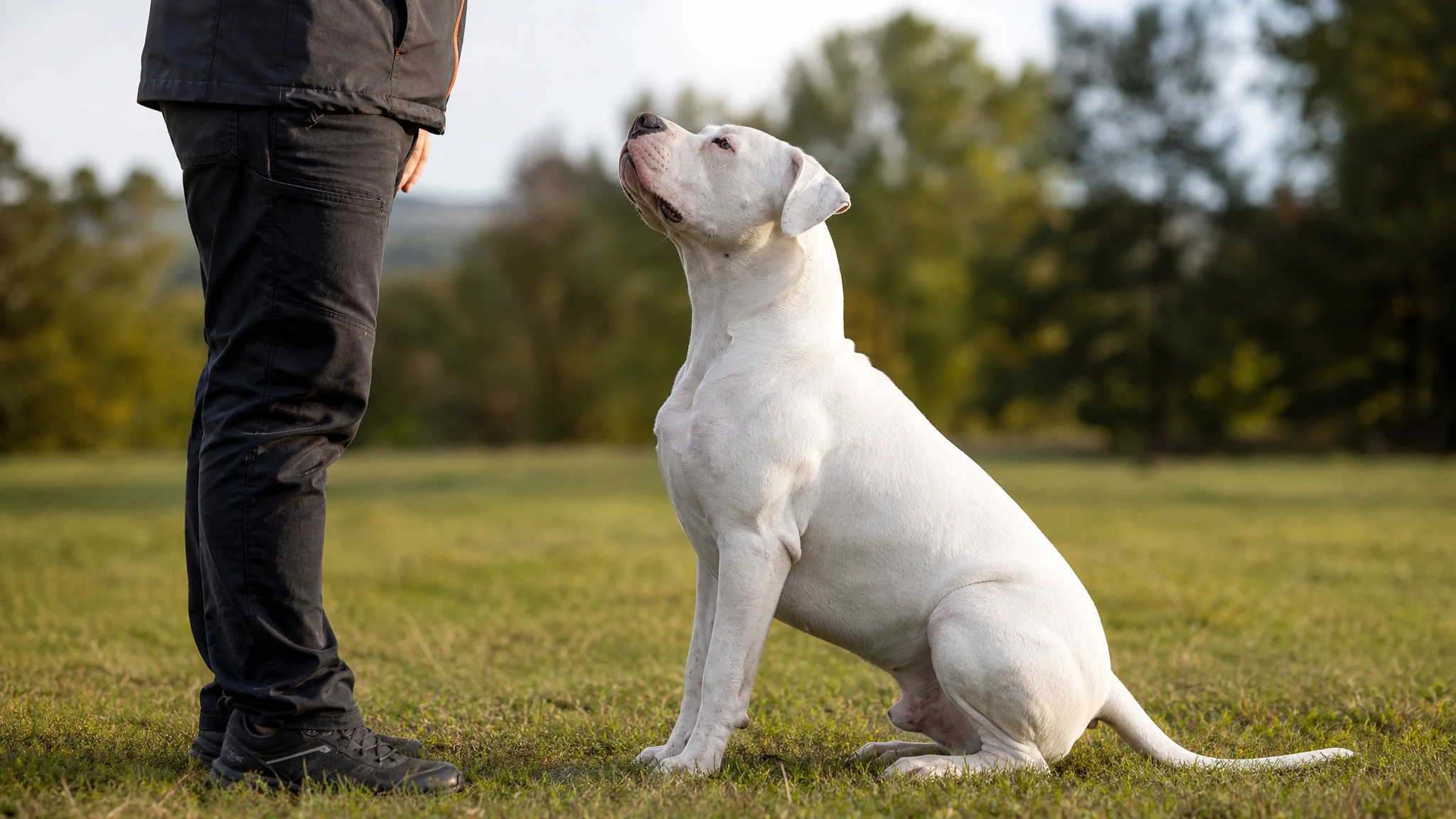
General training information. Every dog is an individual; for health or behavior concerns, see your veterinarian.
Dogo Argentino training starts with understanding the dog you are working with. This is a big, athletic, courageous breed that was built for serious work. It can be a loyal and rewarding companion, but it asks a lot of its owner.
This guide covers how to train a Dogo Argentino from the first weeks at home through adulthood. It explains why the breed's history shapes everything, which methods fit it, how much exercise and mental work to plan for, and where owners most often run into trouble. Individual dogs vary, so treat every trait below as a tendency and not a promise.
Table of Contents
- Key Takeaways
- What the Dogo Argentino Was Bred For and Why It Matters
- Is This Breed Right for Your Training Style?
- Training Stages: Puppy to Adult
- Motivation That Works for a Dogo Argentino
- Exercise and Mental Work
- Challenges to Plan For
- Health, Growth and Training
- Sources
Key Takeaways
- The Dogo Argentino was created in Cordoba, Argentina, by Dr. Antonio Nores Martinez to protect family and property and to hunt large game and destructive predators, according to the Dogo Argentino Club of America.
- PetMD and Chewy describe a dog that needs a confident owner, consistent commitment, and an independent streak to work with. It suits experienced owners.
- Chewy recommends positive reinforcement and starting socialization as soon as possible.
- Chewy says the breed needs at least an hour of intense exercise and activity every day.
- PetMD lists strong prey drive, boredom-driven destruction, and poor fit for apartment living among the known challenges.
- Any health or pain question belongs with your veterinarian, not in a training plan.
What the Dogo Argentino Was Bred For and Why It Matters
Every training plan should begin with the dog's job description. A breed's purpose explains what it finds easy, what it finds exciting, and what it will push back on.
A dog made for protection and big-game work
The Dogo Argentino Club of America says the breed originated in Cordoba province in central Argentina, created by Dr. Antonio Nores Martinez. Its breed standard says the dog was made to protect family and property and to hunt large game and destructive predators such as wild boar, peccaries and pumas.
That is a demanding resume. A dog bred to work close to large, dangerous animals needs physical power, stamina and nerve. Those qualities do not switch off in a living room.
What the breed standard says about temperament
The club's breed standard describes the Dogo as strong, tenacious, rustic, loyal, and above all courageous. Notice what that list means for an owner.
- Strong: A dog of this size can pull you off your feet. Leash skills are a safety matter, not a nicety.
- Tenacious: Tenacity helps in a hunt. In daily life it can look like a dog that keeps trying the same thing, such as a door, a fence, or your sandwich, long after a softer dog would quit.
- Loyal: A bonded dog wants to be with its people. That is something you can build on in training.
- Courageous: A courageous dog does not back down easily. Calm, early, careful exposure to the world matters even more for a dog like this.
Size and build
The breed standard gives male heights of 24 to 26.5 inches and bitch heights of 24 to 25.5 inches, with approximate weights of 88 to 100 pounds for males and 88 to 95 pounds for bitches. A dog this size makes every habit a bigger deal. Jumping up, lunging and pulling are small annoyances in a toy breed. In a Dogo they can hurt someone.
Train the manners you want to see in a full-grown dog, starting on day one.
Is This Breed Right for Your Training Style?
Before any technique, ask an honest question: can you offer what this breed needs?
Confident, consistent and committed
PetMD says the Dogo Argentino needs a confident owner and a consistent commitment. It also calls the breed independent-minded and says it suits experienced owners. Chewy's breed page points the same way.
Confident does not mean harsh. It means calm, clear and predictable. Your dog should know what you expect, and the answer should be the same on Tuesday as it was on Saturday.
A Dogo Argentino Club of America news post, written by a club member about what they call indifference training, stresses follow-through and lifelong consistency. It is one owner's account and not club policy, but the lesson fits what the other sources say. Training is not something you finish at six months and then forget.
Who tends to struggle
- First-time dog owners with no plan for classes or coaching.
- Households where family members apply different rules.
- Owners who cannot give an hour or more of vigorous activity a day.
- People living in small apartments, since PetMD notes the breed is not well suited to apartment living.
If that sounds like you, that is useful information, not a failure. It is far kinder to find out before bringing a puppy home.
Temperament and other dogs
The sources we rely on do not give a clear picture of how Dogos generally get along with other dogs. Ask the breeder or the Dogo Argentino Club of America about the dogs in your dog's line and about realistic expectations. Plan any dog-to-dog introductions with care, whatever you hear.
Training Stages: Puppy to Adult
Training a Dogo Argentino is a long project. Think in stages, and let each one set up the next.
Stage 1: The first weeks at home
Chewy advises starting socialization as soon as possible. In practice, this stage is about safe, happy exposure and a few foundation habits.
- Name and attention: Say the name, reward the look. Repeat many times a day in short bursts.
- Housetraining: Take the puppy out often, reward outdoor success right away, and keep a predictable schedule.
- Crate and settle time: Teach the puppy that quiet rest is normal and pleasant.
- Handling: Practice gentle touching of paws, ears, mouth and collar so grooming and vet visits are easier later.
- Calm greetings: Reward four paws on the floor. Do not let a puppy practice jumping that will be a problem at 90 pounds.
Ask your veterinarian which places are safe for a puppy before vaccines are complete. Socialization does not have to mean crowded spaces. Quiet exposure to new sounds, surfaces, people and sights counts.
Stage 2: Puppy foundations
Once the puppy is settled, build the core skills. Keep sessions short, usually a few minutes, and end on a success.
- Sit, down and stand: Lure with a treat, then fade the lure into a hand signal.
- Come when called: Make recall the best thing in the world. Reward generously and never call your dog to something unpleasant.
- Leave it and drop it: Trade, do not wrestle. These two cues matter a great deal for a breed with strong prey drive.
- Loose-leash walking: Reward the dog for staying beside you. Stop moving when the leash goes tight and move on when it loosens.
- Wait at doors and gates: Teach this early. It protects you and the dog.
A puppy class run by a trainer who uses reward-based methods is a good way to add distractions and get coaching. Look for a trainer who will explain what they do and why.
Stage 3: Adolescence
Adolescence is when many owners feel they have gone backward. A dog that responded well at four months may seem to forget everything at eight. This is common across breeds, and for a strong, independent-minded dog it can feel intense.
- Go back to basics and reward more often, not less.
- Increase exercise and mental work, within what your veterinarian says is safe for a growing dog.
- Keep rules the same. Do not let something slide because it is "just a phase."
- Practice around mild distractions, then slowly raise the difficulty.
Stage 4: Young adult and beyond
As your dog matures, move from teaching skills to proofing them. Proofing means asking for the behavior in new places, around new distractions, and for longer periods.
The club-member essay on lifelong consistency is a good reminder here. Keep rewarding good behavior and keep your rules steady. A trained adult Dogo is a dog whose owner continues to practice.
The Dogo Argentino Club of America promotes the AKC Canine Good Citizen test for Dogos. It is a sensible adult goal because it checks the everyday manners that matter most: calm greetings, polite walking, and staying steady around other people and dogs. Check with the AKC or a local evaluator for how and where the test is offered.
Motivation That Works for a Dogo Argentino
Reward-based training is the right fit
Chewy recommends positive reinforcement for this breed. That matches the position of the American Veterinary Society of Animal Behavior (AVSAB), which supports reward-based training and advises against punishment-based methods. This guide follows the same approach.
That means we do not recommend shock, prong or choke collars, alpha rolls, scruffing or dominance-style handling. With a strong, courageous dog, harsh methods risk fear, stress and a damaged bond. They also do not teach the dog what to do instead.
How to use rewards well
- Find the dog's currency: Some dogs work for small soft treats, some for a favorite toy, some for praise and a game. Try several and watch the response.
- Reward right away: A reward works best within a second or two of the behavior.
- Pay more for harder work: A recall away from a distraction deserves a much better reward than a sit in the kitchen.
- Mix up the rewards: Once a behavior is solid, reward it on a less predictable schedule, but keep surprising the dog with a great payoff now and then.
- Use part of the meal: Training with some of the dog's daily food helps avoid overfeeding. Ask your vet about portions.
Working with an independent mind
PetMD calls the breed independent-minded. Independent dogs often ask, "What is in it for me?" That is not defiance. It is a dog that thinks for itself.
Make cooperation worth it. Keep sessions short and varied, and make the payoff clear. When your dog ignores a cue, ask yourself whether the cue was taught well, whether the setting was too hard, and whether the reward was good enough. Do not repeat the cue louder. Lower the difficulty and try again.
Calm is a skill too
A powerful dog needs to learn how to settle. Reward calm behavior when it happens on its own. Practice mat training, where the dog lies on a bed and relaxes for longer and longer periods. Calm can be taught, and it makes every other lesson easier.
Staying consistent as a household
Hold a short family meeting. Agree on the cues, the rules, and who rewards what. If one person allows the couch and another does not, the dog learns that rules are optional.
Exercise and Mental Work
How much exercise is enough
Chewy says the Dogo Argentino needs at least an hour of intense exercise and activity every day, and PetMD says the breed needs lots of daily exercise. An athletic dog with a working past does not do well on a short stroll around the block.
Good options include:
- Brisk walks and hikes on a secure leash.
- Structured fetch or tug with clear rules, including a reliable drop cue.
- Running in a securely fenced area.
- Swimming, if your dog enjoys it and your vet agrees it suits your dog.
Puppies and adolescents are still growing, so ask your veterinarian how much and what kind of exercise is right at each age. Avoid hard, repetitive, high-impact work for a young dog until your vet says it is fine.
Mental work counts just as much
PetMD says the breed can become destructive when bored. Physical exercise alone is often not enough. Add brain work every day.
- Food puzzles and snuffle mats: Make meals take effort.
- Scent games: Hide treats around a room or yard and let the dog find them.
- Short training sessions: Practice a known cue, then add a new one.
- Trick training: Tricks are fun, build your communication, and keep the dog thinking.
- Chew time: Provide safe chews, chosen with your vet's advice.
Jobs and activities
PetMD lists hunting as the historic job, and military or police work, search and rescue and service work as roles the breed has filled. Most pet owners will not do any of those, but the idea is useful. Give your dog a job. That might be scent games, structured fetch, carrying a backpack on hikes (check with your vet first), or working toward the Canine Good Citizen test.
If you are curious about organized activities, contact the Dogo Argentino Club of America and ask what the club recommends for the breed.
Challenges to Plan For
Being honest about the hard parts is the best favor you can do a future owner. These come from PetMD's list of known challenges and from the breed's history.
Strong prey drive
PetMD notes that the breed has a strong prey drive and needs a leash or a fenced area. This follows directly from its history of hunting large game. Do not rely on voice control near wildlife, small animals, or roads.
- Use a secure leash in any unfenced area.
- Check fences for gaps, weak spots and places the dog could dig under or climb over.
- Practice "leave it" and recall every day, in easy settings first.
- Be careful around cats, small pets and wildlife. Ask your breeder and your vet for guidance before any introduction.
Boredom and destruction
A bored Dogo can wreck a house. Prevent it rather than punish it. Give enough exercise and brain work, use a crate or a safe room when you cannot supervise, and keep the dog's chew toys fresh. If a dog has destroyed something, the fix is a better plan, not an angry reaction after the fact. Dogs do not connect a scolding to something they did hours ago.
Apartment living
PetMD says the breed is not well suited to apartment living. A large, high-energy dog in a small space with little outdoor access is a hard match. If you live in an apartment and are still considering a Dogo, think carefully about how you would meet the exercise needs every single day, in all weather.
Socialization and strangers
Chewy says Dogos are kid-friendly when properly socialized and trained. PetMD says they are good playmates for older children who know how to interact with dogs, and that supervision is needed. Take that seriously.
- Always supervise time between the dog and children.
- Teach children how to behave around a dog: no climbing, no grabbing, no bothering a dog that is eating or resting.
- Give the dog a safe place to retreat.
- Keep early experiences with new people calm and positive.
Because the breed was made to protect, it is wise to take guarding-type behaviors seriously. If you see a dog that stiffens, stares or growls at people, work with a qualified, reward-based trainer or a veterinary behaviorist early.
Noise, shedding and daily life
PetMD describes the breed as generally quiet. It also says the Dogo sheds regularly year-round, and Chewy adds that shedding is heavier in fall and spring. Training can help here too. Teach your dog to accept brushing and handling as a calm, rewarded routine.
When to get help
Bring in a professional if you see any of the following:
- Growling, snapping or biting.
- Fear or reactivity that is getting worse.
- Sudden behavior changes, which can have a medical cause.
- Problems you cannot solve after steady, reward-based effort.
Start with your veterinarian to rule out pain or illness. Then look for a trainer or behavior professional who uses reward-based methods consistent with AVSAB guidance. Ask about their methods before you hire anyone.
Health, Growth and Training
Health and training are linked. A dog in pain cannot learn well, and a growing dog needs a sensible exercise plan.
Puppy growth
PetMD recommends large-breed puppy food and notes that rapid growth can strain joints. It also says puppies can eat up to three meals a day. Talk with your veterinarian about the right food, portions and exercise limits for your puppy. Do not use this guide to set a diet or give supplements.
Health screening and your breeder
The Dogo Argentino Club of America's health program lists required screening for congenital deafness (an OFA evaluation based on a BAER test), hip dysplasia (an OFA or PennHIP evaluation), and a cardiac evaluation at 12 months or older by a cardiologist. It also lists elective choices, including an OFA elbow evaluation, autoimmune thyroiditis testing, a CAER eye exam, or CHIC DNA repository participation. The club says its health program also added disproportionate dwarfism to its genetic testing.
Ask any breeder to show you results for the puppy's parents, and confirm current requirements with the club. Deafness matters for training in particular, since a deaf dog needs hand signals and different recall planning. Talk with your veterinarian about hearing if you have any concern.
Conditions to know about
PetMD lists hip dysplasia, periodontal disease, gastric dilatation-volvulus (GDV), deafness, laryngeal paralysis and hypothyroidism among the common health issues. This is not a checklist for you to diagnose at home. If your dog shows signs of pain, breathing trouble, a swollen belly or any sudden change, call your veterinarian right away.
PetMD gives a typical life expectancy of 9 to 15 years. That is a long relationship, which is another reason to treat training as a lifelong habit.
Putting It All Together
Here is a simple way to start.
- Be honest about whether your home, time and experience fit the breed.
- Choose a breeder who shares health results, and check requirements with the Dogo Argentino Club of America.
- Start socialization and handling right away, with your vet's guidance on safety.
- Teach foundation skills with rewards: recall, leave it, drop it, loose leash and settling.
- Plan at least an hour of real exercise a day for an adult, plus daily mental work.
- Secure your fences and use a leash outside them.
- Keep every family member on the same rules.
- Keep practicing for the dog's whole life.
The best dogo argentino training tips come down to patience, structure and kindness. This is a courageous and loyal dog with a demanding history. If you give it clear rules, plenty of purposeful activity and rewards it cares about, you give yourself the best chance at a well-mannered companion. No method can promise a particular result, since every dog is different, but a steady, humane approach is the right place to start.
Sources
- Dogo Argentino Club of America
- Dogo Argentino Club of America, Breed History
- Dogo Argentino Club of America, Breed Standard
- Dogo Argentino Club of America, Health Programs
- Dogo Argentino Club of America news post (owner essay on indifference training)
- PetMD Dogo Argentino breed page
- Chewy breed education page: Dogo Argentino