How Much Exercise Does a Dogo Argentino Need? Plus Brain Games
General training information. Every dog is an individual; for health or behavior concerns, see your veterinarian.
The Dogo Argentino was built to work. The Dogo Argentino Club of America breed standard says the breed was created to protect family and property and to hunt large game and destructive predators such as wild boar, peccaries and pumas. A dog with that job history does not do well on a couch with a short loop around the block.
So how much exercise does a Dogo Argentino need, and what do you do with the brain once the body is tired? This guide walks through both, step by step. Individual dogs vary, so treat the numbers as a starting point and bring your own dog's needs to your veterinarian.
What You Need Before You Start
You do not need much equipment. Most of this list is basic gear and household items.
- A sturdy flat collar or a well-fitted harness, and a standard leash. Avoid prong, choke and shock collars. They are not part of humane, reward-based training.
- A long line for practice in open spaces, used only where it is safe and legal.
- A securely fenced area, if you have one. PetMD notes the breed has strong prey drive and needs a leash or fenced area.
- Small, soft, high-value treats that you can use in training.
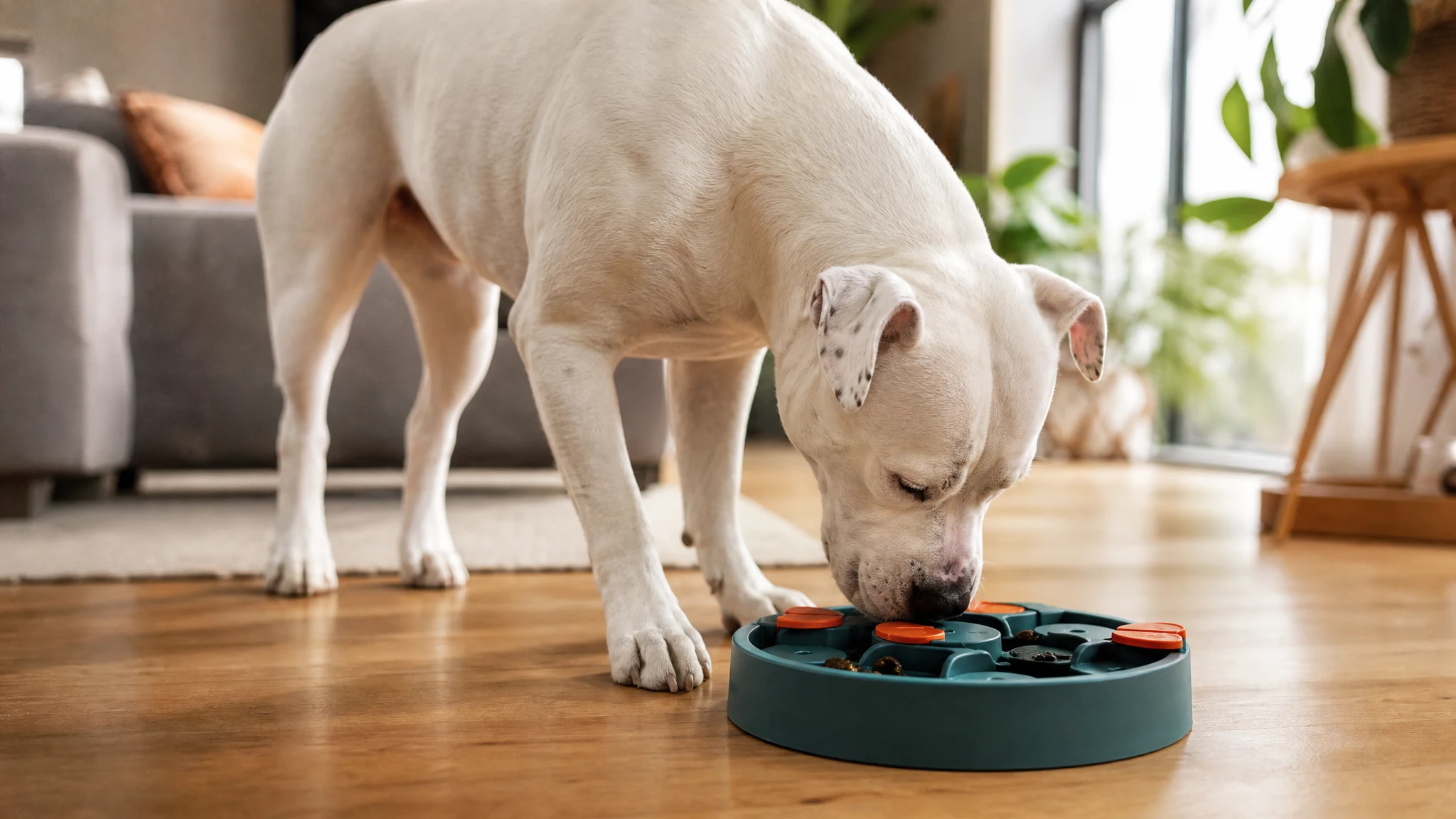
- A puzzle feeder or snuffle mat. A muffin tin with tennis balls over kibble also works.
- A few old towels, cardboard boxes and paper bags for homemade games.
- A notebook or phone notes to track what your dog did each day and how they seemed afterward.
How Much Exercise Does a Dogo Argentino Need?
Chewy's breed education page describes the Dogo as athletic, with a matching energy level. It says the breed needs at least an hour of intense exercise and activity every day. PetMD agrees the breed needs lots of daily exercise.
That is a floor for a healthy adult, not a ceiling. Think of it as an hour of real activity, plus a calm home life and mental work on top.
Two other points from PetMD matter here. The breed is not well suited to apartment living, and it can become destructive when bored. Both are a warning. If the daily outlet is missing, the energy tends to find its own.
Exercise by life stage
| Life stage | What the sources say | What to do |
|---|---|---|
| Puppy | PetMD says rapid growth can strain joints and recommends large-breed puppy food. | Keep play short, varied and on forgiving ground. Ask your vet for an age-based plan. |
| Adult | Chewy says at least an hour of intense exercise and activity every day. | Split activity into two or three sessions. Mix movement with brain work. |
| Senior | PetMD gives a typical life span of 9 to 15 years. No senior exercise numbers are given. | Ask your vet how to adjust. Keep up the mental games. |
Step 1: Set a Realistic Baseline for Your Dog's Age
Start with where your dog is today, not where the breed description says they should be.
Puppies. The sources do not give a minutes-per-day figure for Dogo puppies, so do not invent one. What they do say is useful. PetMD warns that rapid growth can strain joints, and it lists hip dysplasia among the breed's common health issues. The Dogo Argentino Club of America's health program also calls for hip evaluation in breeding dogs.
In practice, that points toward short bursts of play, gentle walks and plenty of rest rather than long forced runs, repeated stairs or hard jumping. Ask your veterinarian what is right for your puppy's age and growth stage.
Adults. Work up toward the hour of intense activity Chewy describes. If your dog has been sedentary, build over several weeks rather than all at once.
Seniors. Keep moving, but let your veterinarian guide the pace and surfaces. Mental games become even more valuable when the body slows down.
Step 2: Build a Daily Exercise Plan
A good Dogo day has structure. Here is a simple template for a healthy adult. Adjust it for your dog's age, fitness and your vet's advice.
- Morning: a brisk leashed walk or a jog, if your vet agrees the dog is fit for it.
- Midday: a short training session and a puzzle feeder meal.
- Late afternoon: a fetch or flirt-pole session in a fenced area, or a hike on a long line where allowed.
- Evening: a calm sniff walk and a settle on a mat.
Several shorter sessions are easier on you and often easier to manage than one marathon. They also give you more chances to practice manners.
Ask your veterinarian about the timing of meals and hard exercise. PetMD lists gastric dilatation-volvulus (GDV) among the breed's common health issues. Your vet can explain what to watch for and how to schedule feeding around activity. Call them right away if something seems wrong.
Step 3: Keep Prey Drive Safe
PetMD lists strong prey drive as a known challenge for the breed. That affects how you exercise, not just how much.
- Walk on leash in any unfenced or unfamiliar area.
- Use a fenced area for off-leash play, and check the fence regularly.
- Teach a reliable "look at me" and a recall with treats, starting somewhere quiet and building up to distractions slowly.
- Keep your distance from squirrels, cats and wildlife until your dog can reliably focus on you.
The breed's history is a reason for planning, not for fear. Individual dogs vary, and so does how they react to other animals. The sources reviewed do not give a rating for how Dogos get along with other dogs, so check with the Dogo Argentino Club of America or your own trainer for guidance about your dog.
Step 4: Add Sniff Walks
A sniff walk is a walk where your dog sets the pace and the nose does the work. It is one of the easiest forms of Dogo Argentino mental stimulation, and it costs nothing.
- Choose a safe, quiet route with grass, trees and varied smells.
- Clip the leash to a harness or flat collar and give your dog a few feet of slack.
- Let your dog stop, sniff and choose the direction for part of the walk.
- Pause when they pause. Do not hurry them along.
- Finish with a short, calm cue such as "let's go" and a treat when they turn toward you.
The Dogo was developed to hunt, so following a trail of scent suits the breed's original purpose. A fifteen to twenty minute sniff walk can feel more satisfying to many dogs than the same time spent marching in a straight line. Many owners find their dogs settle better afterward, though results vary.
Step 5: Feed Meals Through Puzzles
Dogo Argentino mental stimulation does not have to take extra time. Turn part of a meal into a task.
- Start easy. Put kibble in a snuffle mat or a simple puzzle feeder so your dog can win quickly.
- Increase difficulty slowly. A dog who gets frustrated or gives up needs an easier puzzle.
- Try a muffin tin. Put kibble in some cups and cover them with tennis balls.
- Scatter feed. Toss part of a meal across the grass or a towel and let your dog hunt for it.
- Pick up the puzzle when your dog is done so it does not become a chew toy.
PetMD notes puppies can eat up to three meals a day. Puzzle feeders fit nicely into those meals. Ask your veterinarian how much to feed and how to count treats and puzzle food toward the daily total.
Do not leave a bored dog alone with a puzzle and hope it solves everything. Puzzles help, but they do not replace exercise or time with you.
Step 6: Play Training Games That Fit the Breed's Job
The breed standard describes a dog created to protect family and property and to hunt large game. You can honor that history with games that use the nose, the body and the brain. These are safe, reward-based choices.
Find It
Toss a treat on the floor and say "find it." Then hide treats around one room, then several rooms. Start easy and make it harder as your dog learns the game. This builds the trailing and searching skills that match the breed's hunting past.
Scent trail
Drag a treat or a scented cloth along the ground in a short line and hide it at the end. Lead your dog to the start and let them follow. Lengthen the trail over time.
Search the yard
Hide a favorite toy or a few treats in a fenced yard while your dog waits. Release them with a cue and praise the discovery. PetMD lists search and rescue among the jobs Dogos do, and this is a gentle first taste of that kind of work.
Mat and settle games
A guardian dog also needs to learn to relax. Reward your dog for lying on a mat, then for staying there while you move around. Build up to longer stays and mild distractions. This is the calm counterpart to the high-energy games above.
Basic skills as games
Short, fun sessions of sit, down, touch and recall keep the mind busy. Chewy recommends positive reinforcement and starting socialization as soon as possible. For a deeper plan, see the complete guide to Dogo Argentino training.
The Dogo Argentino Club of America promotes the AKC Canine Good Citizen test for Dogos. Working toward it gives structure to your training games.
Tips for Success
- Keep sessions short. Five to ten minutes of focused training often works better than a long, tiring session. Stop while your dog is still keen.
- Be consistent. PetMD and Chewy describe the breed as needing a confident owner and steady commitment. A club member's essay on the club's site stresses follow-through and lifelong consistency. It is one owner's account, not club policy, but the point is a fair one.
- Rotate the games. Change the puzzle, the route or the hiding spots so the work stays interesting.
- Reward what you like. Treats, praise and play all count. Reward-based methods are the approach supported by the American Veterinary Society of Animal Behavior.
- Watch the signals. Heavy panting, limping, lagging or reluctance to keep going are reasons to stop and call your veterinarian.
- Socialize early. Chewy says the breed can be kid-friendly when properly socialized and trained. PetMD says Dogos can be good playmates for older children who know how to interact with dogs, and that supervision is needed.
Common Mistakes to Avoid
- Doing only physical exercise. A tired body does not always mean a settled mind. Mix movement with brain games.
- Overdoing it with a puppy. PetMD warns that rapid growth can strain joints. Hard, repetitive exercise is a poor trade for a young dog.
- Skipping the fence or the leash. Strong prey drive means one moment of freedom can cause real trouble.
- Relying on the yard. A fenced yard is helpful, but a dog left alone in it will not exercise itself in a useful way.
- Using harsh tools. Shock, prong and choke collars, alpha rolls, scruffing and dominance methods are not part of humane training and can make behavior problems worse.
- Turning guarding into a game. The breed has a protective history, but encouraging aggression is not a hobby to try at home. If you want protection-style or bite work of any kind, speak with a qualified, reward-based professional.
- Ignoring boredom. PetMD says the breed can become destructive when bored. Chewed furniture is often a sign of an unmet need, not a bad dog.
What Results to Expect
With a steady routine, many owners see a calmer dog at home, better focus on walks and fewer boredom-driven habits like chewing. It can take several weeks to notice the change, and some dogs take longer. Your dog's age, health, background and temperament all play a part.
The goal is not to wear your dog out. It is to give a capable, athletic, intelligent dog a way to use their abilities, so they can settle when it is time to settle. If problems continue, talk with your veterinarian to rule out health causes, then with a qualified reward-based trainer.
The Dogo Argentino Club of America's health program covers hip dysplasia, deafness and cardiac screening, among other tests. If you are choosing a puppy, ask the breeder about these results. Questions about your own dog's joints, heart, hearing or weight belong with your veterinarian.
Quick Daily Checklist
- At least an hour of real activity for a healthy adult, split into sessions.
- One sniff walk.
- One puzzle meal or scatter feed.
- One short training game.
- One calm settle on a mat.
- A note on how your dog behaved that evening.