Leash Training a Dogo Argentino: Pulling, Lunging and Loose-Leash Walking
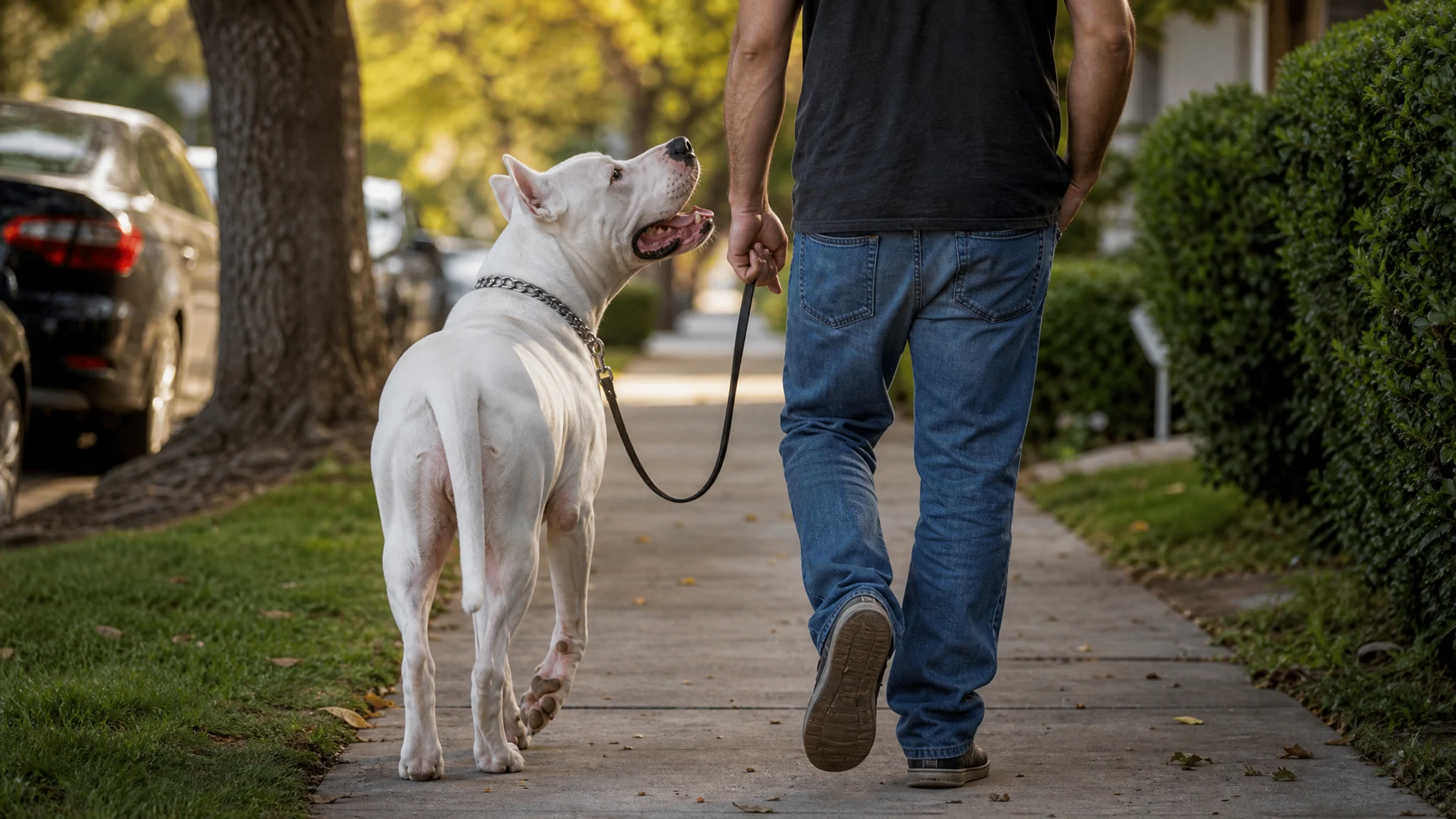
General training information. Every dog is an individual; for health or behavior concerns, see your veterinarian.
A Dogo Argentino on a leash is a lot of dog. The Dogo Argentino Club of America breed standard lists approximate weights of 88 to 100 pounds for males and 88 to 95 pounds for bitches. When a dog that size drags you down the sidewalk, it stops being a training quirk and becomes a safety problem.
This guide covers Dogo Argentino leash training from the ground up. You will learn why the breed pulls, what gear to use, a step-by-step method for loose-leash walking, and how to handle lunging. For the wider picture, see the complete guide to Dogo Argentino training.
Why a Dogo Argentino Pulls on the Leash
Pulling is rarely stubbornness for its own sake. It usually has a few simple causes, and some of them tie back to how this breed was built.
- Breed purpose. The Dogo Argentino Club of America says the breed was created to protect family and property and to hunt large game and destructive predators such as wild boar, peccaries and pumas. A dog bred to range after big game has a lot of forward motion built in.
- Prey drive. PetMD notes a strong prey drive and says the breed needs a leash or a fenced area. A squirrel, a cat or a rabbit can turn a calm walk into a sudden surge.
- Energy. Chewy describes the breed as athletic with a matching energy level and recommends at least an hour of intense exercise and activity every day. A dog that has not burned off energy will pull harder.
- Independence. PetMD says the breed is independent-minded and does best with an experienced, confident owner who stays consistent.
- Plain old reward. Every time pulling gets the dog to the smell, the park or the other dog, pulling wins. Dogs repeat what works.
Individual dogs vary. Some Dogos pull hard, others barely tug. Train the dog in front of you, not the stereotype.
Materials You Will Need
- A flat collar that fits well, for ID tags and for dogs that do not pull hard.
- A well-fitted front-clip harness. The leash attaches at the chest, so pulling turns the dog toward you instead of letting it power forward. Ask a store fitter or your veterinarian to check the fit, since a poor fit can rub or slip.
- A standard 4 to 6 foot leash made of sturdy nylon or leather. Skip retractable leashes. They teach a dog that pulling extends the walk and are hard to control with a strong dog.
- Small, soft, high-value treats that you can deliver fast. Pea-sized pieces keep the calories low. Ask your veterinarian how treats fit into your dog's daily food.
- A treat pouch so rewards are at your hip, not in a pocket.
- A quiet starting place such as a backyard, garage or empty parking lot.
What to leave in the closet: prong collars, choke chains and shock collars. They work by causing discomfort, and the American Veterinary Society of Animal Behavior (AVSAB) supports reward-based training instead. Chewy also advises positive reinforcement for this breed. Aversive tools can also make a dog link painful feelings to whatever it is looking at, which is a bad outcome for a dog that already lunges.
How to Leash Train a Dogo Argentino: Step by Step
Work in short sessions of five to ten minutes. Start where there are few distractions and add difficulty slowly.
Step 1: Get comfortable with the gear
Let your dog sniff the harness and leash. Pair each step with a treat: harness appears, treat. Harness goes on, treat. Leash clips on, treat. A dog that enjoys the gear is easier to teach than one that dreads it.
Step 2: Teach a reward position
Decide which side your dog will walk on and stay with it. Stand still with the dog beside you. Reward every moment the dog is next to your leg, even if you have not moved a step. Use a marker word such as "yes" the instant the dog is in position, then deliver the treat right at your hip. This teaches the dog where the good stuff happens.
Step 3: Add one step at a time
Take one step and reward the dog for following. Then two steps. Then three. Keep your hand low and steady so the dog does not jump for treats. If the leash goes tight, stop and reset rather than rushing ahead.
Step 4: Make a tight leash boring
This is the core rule: a tight leash means the walk stops, and a loose leash means the walk continues. When the dog pulls, stand still like a tree. Do not yank or shout. The moment the leash slackens, even slightly, mark and reward, then move forward again. You can also take a calm step backward and reward the dog for turning to follow you.
Be ready for this to be slow at first. A walk that covers one block in ten minutes is normal in the early days.
Step 5: Reward often, then stretch the gaps
At the start, reward every few steps. As the dog improves, reward every five steps, then every ten, mixing it up so the dog stays hopeful. Keep rewarding in more distracting places, since a rule learned in the garage does not automatically hold on a busy street.
Step 6: Move to the real world
Go from the yard to the driveway, then the quiet street, then a busier area. Whenever the dog struggles, move back to an easier spot. If your Dogo cannot walk past a rabbit yard on a loose leash yet, cross the street, add distance and reward calm behavior. Distance is your best friend.
Loose-Leash Games That Help
Games make practice feel less like work, and they suit an athletic breed.
- Follow me. Walk in a zigzag or a wide circle with no warning. Reward the dog every time it catches up and stays beside you. It teaches the dog to keep an eye on you.
- Treat scatter. Toss a few treats on the ground and say "find it." This gives a sniffing dog a job and is a handy reset when the dog is overexcited.
- Check-ins. Wait for the dog to look at you on its own, then mark and reward. Dogs that check in on their own are easier to steer past temptations.
- Sniff breaks. Give a release word such as "go sniff" and let the dog explore on a loose leash for a few moments. Sniffing is part of how dogs enjoy a walk, so using it as a reward often works well.
- Stop and sit. Every so often, pause and ask for a sit, then reward. The dog learns that stopping with you is part of the walk.
Dealing With Lunging at Triggers
Lunging is different from ordinary pulling. The dog is not trying to get somewhere. It is reacting to something it has seen, such as another dog, a cyclist, a squirrel or a stranger. The cause can be excitement, frustration, fear or prey drive, and the right plan depends on which it is.
The sources used for this article do not say how the breed does with other dogs, so check with the Dogo Argentino Club of America or a qualified behavior professional if you are unsure how your own dog will react. If lunging comes with growling, snapping or other signs of aggression, get help from your veterinarian and a reward-based professional right away.
- Find your threshold. This is the distance at which your dog notices the trigger but can still take a treat and think. Start training there.
- Mark and reward the look. When your dog sees the trigger and stays calm, say "yes" and give a treat. The trigger then predicts good things.
- Turn away early. If the dog starts to stiffen or fixate, calmly turn around and walk away before it explodes. Reward when the dog comes with you.
- Close the distance slowly. Only move closer over many sessions, as the dog stays relaxed.
- Plan ahead. Walk at quieter times and choose wide routes. Managing exposure while the dog learns prevents rehearsal of the lunge.
With prey-driven lunges, remember what PetMD says about keeping this breed on a leash or in a fenced area. A dog that has locked onto a target may not hear you at all, so never trust recall off leash in an unfenced place.
Tips for Success
- Exercise first. Chewy recommends at least an hour of intense activity daily. A dog that has had a game of fetch or a sniffy play session will often learn more easily than one full of energy.
- Start early. Chewy advises starting socialization as soon as possible. Puppies can begin the gear games right away. Keep walks gentle, since PetMD notes that rapid growth can strain joints in this large breed. Ask your veterinarian how much exercise is right for your puppy's age.
- Be consistent as a household. Everyone who walks the dog should use the same rules. A club member's essay on the Dogo Argentino Club of America site on "indifference training" stresses follow-through and lifelong consistency. It is one owner's account, not club policy, but the message fits here.
- Keep your own energy calm. A tense owner with a tight grip sends a signal down the leash. Breathe, relax your arm and keep your voice low.
- Practice a few minutes daily. Short, frequent sessions beat one long one.
- Consider the Canine Good Citizen test. The club promotes the AKC Canine Good Citizen test for Dogos, and loose-leash walking is a useful skill to build toward it.
Common Mistakes to Avoid
- Letting the dog pull sometimes. If pulling works even once in a while, the dog will keep trying. Consistency matters most.
- Jerking or yelling. Leash corrections can hurt the dog's neck and shoulders and add stress. They also do not teach the dog what to do instead.
- Using harsh tools. Prong, choke and shock devices are not part of humane, reward-based training.
- Going too far, too fast. Jumping straight to a busy park sets the dog up to fail. Build up slowly.
- Skipping exercise. PetMD notes that the breed can become destructive when bored. A bored, under-exercised dog is also harder to walk.
- Forgetting treats once the dog improves. Fade rewards gradually, not suddenly.
- Expecting an apartment-style routine. PetMD says the breed is not well suited to apartment living, so plan for plenty of safe outlets beyond a quick walk around the block.
What Results to Expect
Progress varies a lot between dogs. With regular, reward-based practice, many owners find that their dog pulls less and checks in more over a few weeks, though some dogs take longer. Loose-leash walking around heavy distractions, such as wildlife or other dogs, often takes months of steady work and may never be perfect.
Expect setbacks during adolescence or after a stressful event. That is normal. Go back to an easier step, reward generously and build up again. If you are struggling, a reward-based trainer can watch you and your dog in person and adjust the plan. Check their methods first, and make sure they follow AVSAB-aligned, force-free approaches.
Questions about pain, a sudden change in behavior or your dog's physical fitness for exercise belong with your veterinarian. PetMD lists hip dysplasia among the health concerns seen in the breed, and a dog that is sore may pull, balk or react differently on walks.
Final Thoughts
A Dogo Argentino that walks politely on a loose leash is a pleasure to be out with. It takes patience, good gear, plenty of treats and a clear rule: a loose leash moves forward and a tight one goes nowhere. Keep sessions short, respect the breed's drive and build up one small win at a time.