Common Dogo Argentino Behavior Problems and the Instinct Behind Each
General training information. Every dog is an individual; for health or behavior concerns, see your veterinarian.
Most Dogo Argentino behavior problems make sense once you know what the breed was built to do. The Dogo Argentino Club of America says the breed was created in Cordoba, Argentina, by Dr. Antonio Nores Martinez to protect family and property and to hunt large game and destructive predators such as wild boar, peccaries and pumas.
That job description explains a lot. A dog bred to chase, grip and keep going will not read your living room the way a pet-store companion breed does. This guide covers the problems owners report most, the instinct behind each, and a step-by-step plan for prevention and training. Individual dogs vary, so treat each section as a starting point.
What You Need Before You Start
- A secure, fully fenced area and a standard flat collar or a front-clip harness, plus a six-foot leash and a long line for practice.
- Small, soft treats your dog loves, kept separate from regular meals.
- Sturdy chew items and food puzzles for daily mental work.
- A crate or a gated resting area for a calm place to settle.
- A notebook or phone notes to track triggers, times and progress.
- A contact for a certified trainer and your veterinarian, in case you need them.
Every method here is reward-based, in line with the American Veterinary Society of Animal Behavior (AVSAB). Shock, prong and choke collars, alpha rolls, scruffing and dominance tactics are not part of this plan, and they can make behavior worse.
Step 1: Understand the Breed Before You Label the Dog
The breed standard from the Dogo Argentino Club of America describes the temperament as strong, tenacious, rustic, loyal and above all courageous. Those are admirable traits, and they also mean a Dogo can be a lot of dog when training is thin.
PetMD lists the breed's known challenges as a strong prey drive that calls for a leash or fenced area, a tendency to become destructive when bored, and poor suitability for apartment living. PetMD and Chewy also describe a dog that needs a confident owner and steady commitment, and that suits experienced owners.
PetMD describes the breed as generally quiet. If your Dogo suddenly barks a lot, look at unmet needs or health first. Do not assume it is a trait of the breed.
For the full foundation, including daily structure and cues, see our complete guide to training a Dogo Argentino.
Step 2: Fix Chasing and Prey Drive
The instinct
The breed was developed to pursue large game. When a squirrel, cat or jogger moves quickly, your dog's instinct may take over before your cue registers. PetMD notes the strong prey drive and says the dog needs a leash or fenced area.
Prevention
- Keep your dog on a leash or in a secure fenced area whenever you are outdoors.
- Check fence height and gaps, and supervise yard time.
- Avoid off-leash situations around small animals and traffic.
Training plan
- Teach a "look at me" cue indoors. Say the cue, and reward the instant your dog meets your eyes.
- Practice in the yard, then on quiet streets, always at a distance where your dog can still take a treat.
- When a trigger appears far away, mark and reward the glance toward you, then move off calmly.
- Slowly reduce the distance to triggers over many weeks. Go back a step if your dog stiffens or fixates.
- Add a turn-and-walk-away cue so you have a way out of tough moments.
Expect gradual change. With steady practice, many dogs get better at checking in around triggers, but a strong prey drive does not disappear, so management stays in place for life.
Step 3: Prevent Boredom and Destruction
The instinct
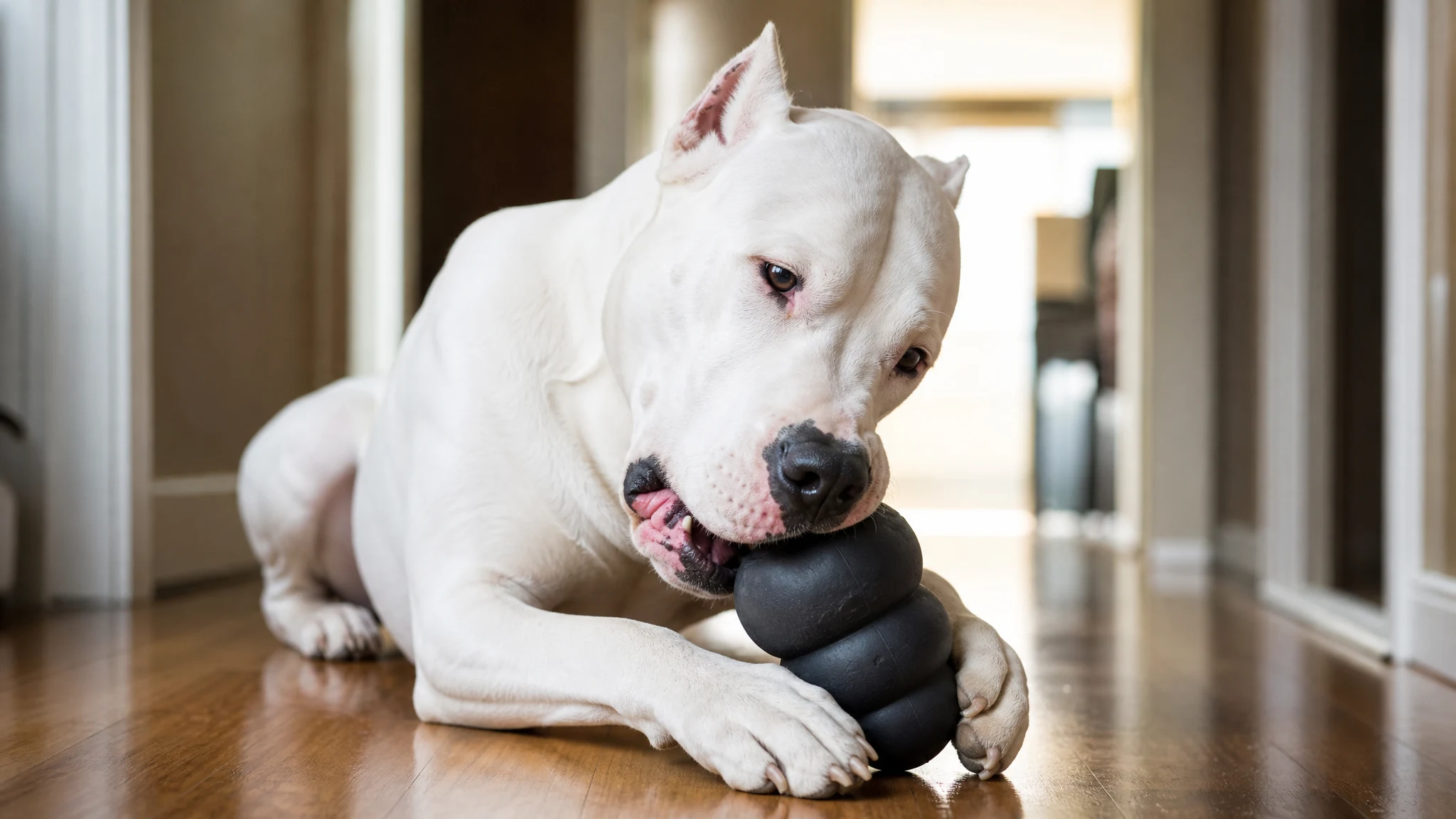
This is an athletic, working-bred dog. Chewy says the breed needs at least an hour of intense exercise and activity every day, and PetMD describes lots of daily exercise. PetMD also warns that a bored Dogo can become destructive. Chewed furniture and dug-up gardens are often a dog finding its own job.
Prevention
- Schedule exercise before you leave the house, not only after.
- Rotate chew items and food puzzles so they stay interesting.
- Limit unsupervised access to the house while your dog is young or still learning the rules.
Training plan
- Build a daily routine with one or two active sessions and one or two shorter training sessions.
- Feed some meals from puzzles or scatter them in the yard so your dog has to work for them.
- Teach a settle cue on a mat. Reward calm lying down, then lengthen the time in small steps.
- Practice short crate or gated-area stays while you are home, then while you step out for a moment.
- Redirect chewing to approved items, and reward your dog for picking them up.
Scolding after the fact does not teach a dog anything useful. Prevention and a full daily schedule do most of the work.
Step 4: Handle Independence and Selective Listening
The instinct
PetMD and Chewy describe the Dogo as independent-minded. A dog bred to make decisions while hunting may question a cue that has no payoff. This is not stubbornness for its own sake, and it is not a sign you need to get tougher.
Prevention
- Start training the day your puppy comes home, with short and upbeat sessions.
- Make sure everyone in the household uses the same cues and rules.
Training plan
- Use high-value rewards and make cues worth following.
- Only ask for a cue you have set your dog up to succeed at. Lower the difficulty if your dog fails twice in a row.
- Follow through every time. If you ask for a sit, help your dog sit and reward it, rather than repeating the cue over and over.
- Practice in new places, one new variable at a time.
- Keep up the work for life, not only through puppyhood.
A club member's essay on the Dogo Argentino Club of America site about "indifference training" stresses follow-through and lifelong consistency. It is one owner's account, not club policy, but the point about consistency matches what Chewy and PetMD say about the breed.
Step 5: Socialize Early and Keep It Positive
The instinct
The breed was created in part to guard family and property, and the standard calls it courageous. A dog with that background benefits from learning early what is normal. Chewy advises positive reinforcement and starting socialization as soon as possible.
Prevention
- Introduce new people, sounds, surfaces and places in small, pleasant doses.
- Ask your veterinarian which places are safe while your puppy's vaccinations are in progress.
- Keep early meetings calm and let your puppy walk away when it wants to.
Training plan
- Make a list of ten new things per week, such as a hat, an umbrella, a delivery person at a distance, or a different floor surface.
- Pair each with treats so the new thing predicts something good.
- Watch your dog's body language. Stiff posture, a fixed stare or pulling away means you are too close.
- Work toward the AKC Canine Good Citizen test, which the Dogo Argentino Club of America promotes for Dogos. It gives you a clear set of real-world skills to practice.
Our sources do not rate how Dogos get along with other dogs, so check with the Dogo Argentino Club of America or a reputable breeder about what to expect. Introduce other dogs carefully and one at a time, and do not force greetings.
Step 6: Manage Play With Children
The instinct
This is a large, strong dog. The standard lists males at roughly 88 to 100 pounds and bitches at roughly 88 to 95 pounds. Even friendly play can knock over a child. Chewy says Dogos are kid-friendly when properly socialized and trained, and PetMD calls them good playmates for older children who know how to interact with dogs, with supervision.
Prevention and training plan
- Supervise every interaction between your dog and children.
- Teach children to be calm, to avoid grabbing or hugging the dog, and to leave it alone when it is eating or resting.
- Teach your dog to keep four paws on the floor for attention, by rewarding it for sitting when someone approaches.
- Give your dog a quiet retreat that children are not allowed to enter.
- End play sessions before the dog gets overexcited.
Step 7: Plan Around Apartment and Space Limits
PetMD says the breed is not well suited to apartment living. If you live in a small space, be honest about whether you can deliver the daily exercise and mental work. Many problems blamed on the dog are really a mismatch between its needs and its day.
- Add several outings per day, not just one long one.
- Use secure, fenced areas for running, and long-line practice for sniffing and exploring.
- Check your lease and local rules about breeds before you commit, and ask your housing provider or local agency, since those rules vary.
Tips and Common Mistakes
- Skipping exercise. A tired dog is not a trained dog, but an under-exercised Dogo is harder to train.
- Using punishment. Harsh methods can suppress warning signals and damage trust. Stay with reward-based work.
- Inconsistent rules. If one person allows the couch and another does not, your dog learns that rules are optional.
- Trusting the recall too soon. Prey drive can override even a well-practiced cue. Use a leash or a fence.
- Ending training after puppyhood. Adolescents and adults need ongoing practice.
- Ignoring sudden change. New behavior can have a medical cause, so see your veterinarian.
Rule Out Health Issues First
Pain and illness can change behavior. PetMD lists hip dysplasia, periodontal disease, gastric dilatation-volvulus (GDV), deafness, laryngeal paralysis and hypothyroidism among the breed's common health issues. A dog with sore hips may snap when touched. A deaf dog may seem to ignore cues. Only a veterinarian can sort this out, so book a check-up if behavior shifts suddenly or your training plan is not working.
The Dogo Argentino Club of America's health program lists hearing evaluation by BAER test, hip evaluation, and a cardiac evaluation as required screening for breeding dogs. Ask any breeder to show you results.
What Results to Expect
Progress depends on your dog's age, history and how steady your routine is. With regular practice, many owners see better focus, calmer indoor behavior and fewer destructive episodes over several weeks to months. Results are not guaranteed, and instincts such as prey drive are managed, not erased. Keep notes and compare month to month, not day to day.
When to Call a Certified Trainer or Veterinary Behaviorist
Get professional help early if you see any of these:
- Growling, snapping or biting toward people or other animals.
- Fixating, stiffening or lunging that you cannot interrupt with treats or distance.
- Repeated escapes or fence-climbing.
- Extreme distress when left alone, or self-injury.
- A behavior that is getting worse despite several weeks of steady work.
Start with your veterinarian. If medical causes are ruled out, ask for a referral to a veterinary behaviorist, or look for a certified trainer who uses reward-based methods and ask about their approach before you book. Avoid anyone who recommends shock, prong or choke collars, alpha rolls or dominance tactics. Medication and supplement decisions belong to your veterinarian.
Bringing It Together
Dogo Argentino problems rarely come from a bad dog. They come from a capable, driven animal whose instincts need outlets, structure and clear communication. Meet the exercise needs, manage prey drive, socialize early and stay consistent for life. Then you will be working with the dog's nature, not against it.